Deliveroo Is Leaving. What Next?
Deliveroo is leaving Singapore. Consolidation is here. The real question is who absorbs the cost and how restaurants protect their margins.
From the Desk of Jonathan Lim, Founder and CEO of Oddle
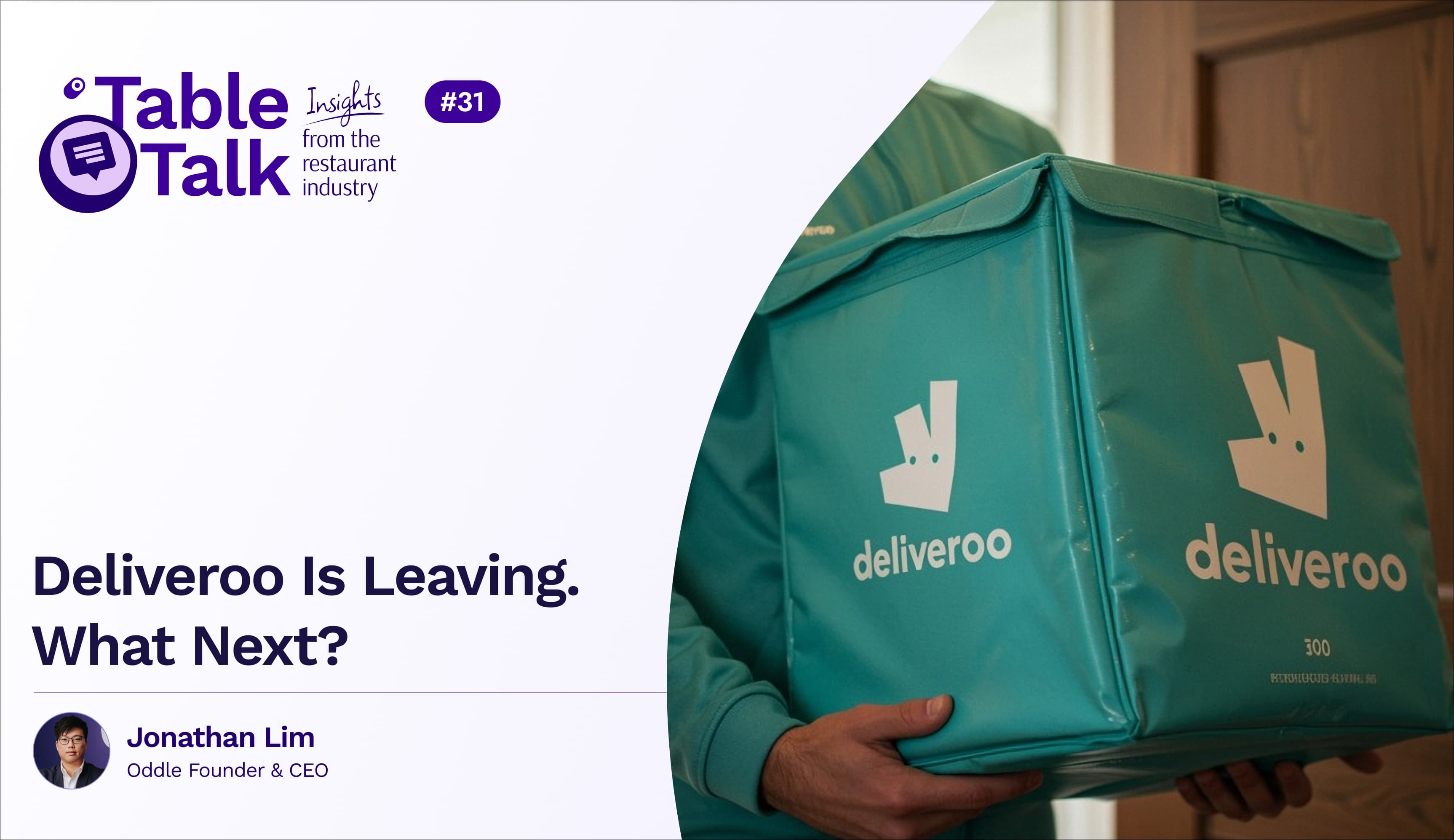
Deliveroo is leaving Singapore.
Some restaurants will panic. Some will shrug. Most will assume nothing really changes.
They’re wrong.
When a delivery market consolidates, the balance of power shifts. And when the balance shifts, someone pays.
The real question is not whether the economics change. It is who absorbs the change.
Singapore has seen this cycle before. A period of aggressive expansion and heavy subsidies is eventually followed by consolidation. One player exits. The field narrows. What comes next is rarely dramatic, but it is structural.
Commissions may not spike overnight. Instead, pressure builds quietly. Visibility becomes paid. Promotions become expected. Defensive advertising becomes normal. Margins compress slowly, almost invisibly.
This is how power concentrates.
Delivery is no longer optional
For many restaurants today, delivery is not incremental revenue. It is structural revenue.
It cushions bad weather. It offsets weak lunch traffic. It fills gaps when dine-in softens. For some brands, it is the difference between a stable month and a worrying one.
And once a revenue stream becomes structural, leverage changes.
Walking away is no longer realistic. The platform understands this as well as you do.
That is when rent becomes permanent.
Why pushing back is harder than it sounds
It is tempting to frame this as a negotiation issue. It isn’t.
Most owners already know commissions are painful. The constraint is capability.
To meaningfully reduce dependence on marketplaces, a restaurant needs four things working together: traffic it can generate independently, a direct ordering channel that converts properly, fulfilment that does not break during peak hours, and a retention engine that systematically brings customers back.
Very few restaurants have all four aligned.
Many have one or two.
Almost none have them integrated.
So when effective take-rates creep upward or terms tighten, the reaction is predictable. Prices are adjusted. Promotions are tweaked. Costs are absorbed. Operations move on.
Because switching off delivery revenue feels riskier than continuing to pay for it.
That is not weakness. It is structural dependence.
An ode to Deliveroo
Before this becomes a morality tale, it is worth acknowledging something uncomfortable.
Food delivery is an extraordinarily difficult business to run well.
It is a three-sided market that must balance orders, riders and merchants simultaneously. If any one side weakens, the entire system strains. Rider supply tightens during peaks. Margins are thin. Customer expectations are immediate. Regulatory shifts add cost and complexity. Platforms are constantly balancing short-term incentives with long-term sustainability.
If you think delivery is simply an app with drivers attached, you have never tried to operate it at scale.
Exits in this industry are rarely about incompetence. More often, they are about economics reaching their natural limit.
What actually matters now
Consolidation does not mean restaurants should panic.
It means they should become disciplined.
Every restaurant already has profitable orders. Not all revenue is equal.
Some customers order high basket sizes. Some repeat predictably. Some represent office group demand or family routines that anchor consistent volume. These are not casual transactions. They are relationships.
Now consider this carefully.
How many of those profitable customers are ordering through a marketplace?
And how many of them could have ordered directly from you?
Every time a loyal customer places an order through a marketplace, you are paying commission on a relationship you already built. Over time, that leakage compounds. What feels like convenience becomes structural margin erosion.
If delivery is survival revenue, protecting your most profitable customers becomes strategic, not tactical.
The fork in the road
In a consolidated market, restaurants tend to drift into one of two positions.
They become price takers, optimising for ranking, discounts and platform visibility.
Or they become demand owners, investing in customer relationships, databases and repeat behaviour.
Price takers compete on exposure they do not control.
Demand owners build habits they can activate.
This shift does not happen overnight. But direction matters.
What to build next
The goal is not independence tomorrow. The goal is leverage over time.
Start by identifying your most profitable customers. Who orders the highest basket sizes? Who repeats frequently? Who orders predictably? If you cannot answer these questions, that is the first blind spot to address.
Capture identity deliberately. Dine-in check-ins, loyalty enrolment, reservation data, receipt QR codes. A restaurant without a database is operating without visibility.
Create a meaningful reason for profitable customers to order direct. Not guilt. Not slogans. Real value. Better bundles. Member-only sets. Free delivery thresholds. Structured return rewards. Direct must feel intentional, not secondary.
Make reordering effortless. Saved favourites. One-click reorder. Simple checkout flows. Your best customers should not need to rediscover you.
Build structured reminders. Seven-day nudges. Twenty-one-day follow-ups. Targeted win-back campaigns for lapsed customers. Consistency compounds.
And ensure you have continuity in fulfilment. You do not need to replace marketplace fleets immediately, but you should not be rebuilding logistics from zero the moment terms shift.
Because they will shift.
The real headline
Deliveroo leaving is not the headline.
Consolidation is.
Consolidation concentrates power. And concentrated power changes economics over time.
Marketplaces are powerful. They are not villains. But they are not designed to protect restaurant margins. They are designed to optimise their own.
That responsibility remains with the restaurant.
Over the next five years, the strongest brands will not be the ones with the highest marketplace volume. They will be the ones that protect their profitable customers, build direct relationships, and reduce leakage before it compounds beyond control.
Consolidation is not a crisis.
It is a signal.
The restaurants that treat it as noise will drift. The restaurants that treat it as structural will build differently.
The choice, as always, is not with the marketplace.
It is with you.
👀 Curious where your restaurant stands today?
Try BrandCheck — it’s free and shows you how customers (and engines) are finding you.
👉 Get your free brand report:
🇸🇬 https://brandcheck.oddle.me/sg
🇲🇾 https://brandcheck.oddle.me/my
🇭🇰 https://brandcheck.oddle.me/hk
🇦🇺 https://brandcheck.oddle.me/au
📬 Subscribe to Tabletalk: Real stories and hard-earned insights from the frontlines of F&B.